
Posts

What it is to bear witness?

To bear witness is a potent act. To bear witness is an antidote to helplessness, it is a testimony to our interconnectedness, and it relieves us of complicity because we allow ourselves to actually see the suffering of the world everywhere. None of us are exempt from the trials of this life. We can’t say “we are all one” and then say “but only when it feels good”.

It is the least we can do for those experiencing tremendous suffering. It takes just a few moments a day, to actually see what is going on and allow our hearts to be opened. To not look away at times of such crisis is what bearing witness asks us to do: it asks us neither to fix nor to withdraw in fear. To bear witness reminds us that there but for grace, go any of us.

We may look at our screens many times a day and see the difficult times this planet is in, but do we see? Will we turn away or will we bear witness? Technology makes more of a demand on us to look, see, and acknowledge what’s so, but we do have still have the free will to turn toward or turn away.

Will we do the inner work required to meet the “barriers to love” within ourselves the poet Rumi speaks about, the barriers to seeing what’s so, with well resourced hearts? If the answer is yes, then our inner work becomes a form of activism: a form of activism that respects all beings.

The reason to do our inner work is to discover that we have so much more to offer the world than our pain, that our hearts are vast, and that we can bear witness to both the love and the suffering of this world.

Shoe Dropping

Many of us know the phrase, “things were going just fine and then the other shoe dropped.” But what if there are actually no shoes that drop at all? What if whatever happens along the way is life unfolding in all its messiness as all one piece. What if when upheaval happens in the middle of our routine, it isn’t something outside of our life, but just life, happening: life doing what it does?

Life from the shoe dropping view…

…however subtle, means anxiety. Spending your life fending off the bad and only wanting the good, is exhausting. Do you have preferences? Of course!

That much used phrase, “it is what it is” invites equanimity. Equanimity is a humbled acceptance, not to be confused with resignation. How do you tell the difference? When you listen to your body with the ear of your heart you will suss out the difference; these distinctions emerge with quiet attention.

Shocking and traumatic events do happen. How we meet life in all its twists and turns determines how we grow. Transformation is on offer the moment a situation arrives in our life that will not bend to our will.

Upheaval is a catalyst for growing and those of us who can learn to work within our constraints, must do so not only for our own well being, but on behalf of those who cannot or will not. The work of our personal healing, offers healing to the world, always.

There’s a trust that is required which holds us while we gradually learn to shift from toggling back and forth between “good and bad” experiences, to meeting life as it is. Trust in life is a gift of being willing and able to engage with what’s present to the best of our ability. Ask yourself what is your relationship to trusting life? That question will point you toward your next healing steps, no dropping shoes required.

Where are you on the journey?

Beginnings imply endings, whether we are conscious of it or not. What’s challenging for most of us are endings and part of that difficulty arises because we aren’t aware that the ending process has phases. When we are disconnected from the natural unfolding of an ending, we are caught in linear thinking: “This will never end!”, “I will never have another relationship, job, or good health again!” “It will always be like this!” When we find ourselves using words like “never” and “always” it’s good to recall that impermanence applies to everything. Nothing is forever but the experience we have of a situation can feel that way!

Here’s why I take the time to write about this at all: an ending process has stages and being able to locate ourselves in those stages will reduce the suffering in our everyday life. We might be able to begin to appreciate the universality of our experience, which is not meant to diminish our experience but to allow us to recognize our shared humanity.

Stages of Endings

Drawing upon the writings of William Bridges, PhD, whom I’ve quoted before from his book “Transitions: Making Sense of Life’s Changes”/(Hachette Book Group) I offer you here a brief overview of the transition process of endings. This book is one of the most useful ones on my bookshelf and I recommend it to people with whom I work, often.

  1. Disengagement–A phase where we are dislodged from what we’ve known, what is familiar: that could be our health, our partner, our home, our partner’s health, our work: this phase involves a loss, something we’ve chosen or something that is beyond our control.
  2. Dismantling–This is a phase usually after disengagement where our identity that was built around the previous structures of home, health, job, etc. unravels piece by piece. Here the things, people, and/or social circles that defined us and defined our responses to the world, are shifting.
  3. Disidentification–Here in this phase we experience a further deconstructing of what we knew as our “previous life”.
  4. Disenchantment–As Dr. B names it, it’s a kind of floating between the worlds and life has a surreal quality. Here this phase our assumptions about reality are challenged.
  5. Disorientation–Here in this phase, what’s gone is gone, we can’t go back to what we knew and we don’t yet have the energy to imagine a new future for ourselves.

It’s important to note that Dr. Bridges makes a distinction between making “changes” which are about reaching a goal, and “transitions” which are about letting go of worn-out ways of being that no longer serve.

Endings include the need to let go. The simple fact is if we don’t come to the place where we can let go, we are not receptive to whatever it is life asks of us next.

Each of us unfolds in our own way. There is however a pattern to transition processes and that pattern is imprinted within the human psyche. We are each part of the natural world and as such we are subject to the same rules of transition as everything else in the universe.

And after the letting go…

comes the “Neutral Zone”. The neutral zone can be (believe it or not!) the most challenging for we humans. Life as we knew it has ended, we’ve consciously let go as best we can and then….what? The ability to stay present and true to ourselves in this place of uncertainty is challenging but necessary. In the neutral zone we must learn to live close to ourselves and listen deeply for proper timing: to move too quickly can ironically slow down the experience of renewal we long for.

The larger cycles of pandemics, political, economic, and social upheaval that are impacting us now, are deconstructing systems and institutions that prevent us from becoming who we need to be. It’s important to name where we are, to seek the support we need, and to trust in the deeper workings of life. This is where our inner work intersects with becoming the change we wish to see in the world.

“No mud, no lotus” ~Thich Nhat Hanh

The lotus flower has a life cycle like no other: each night it drops back into the river water and arises again renewed and sparkling in the morning sun. Its stems are tough, strong, and submerged deep into the dark, rich mud. It is a symbol of feminine resilience and wisdom, regardless of gender.

The lotus flower signals to us that without the slime and the muck of our everyday life there’d be no renewal. It reminds us that everything in our life no matter how messy, awful or dark is fertile ground for our growth. No exceptions! We like to divide our life up into the “good” parts and reject the “bad” parts. No one volunteers for suffering or difficulties but consider for yourself when you’ve done the most growing in your life, probably through some of your biggest challenges: no mud, no lotus.

You are not obliged to be beautiful
You don’t have to shine.
Blooming will happen when it happens.
If you can be still for a moment
you might notice that
the roots that feed you
are still reaching silently through the dark.
~Lynn Ungar

It’s not really what happens to us…
rather, it’s about how we meet our circumstances that offers the possibility of change, real change. We may have to muck about, just like that tough lotus stem in the mud but as the inspiring poem above suggests, “if you can be still for a moment, you might notice the roots that feed you are still reaching silently through the dark.” In this New Year, may your roots grow deep and your lovely face turn toward the sun each day with anticipation.

A Year of Pruning

On January 4, 2021 I went into a 3 week solitary at 8000 feet on the ancestral lands of the Ute and Navajo people in Southern Colorado. My life was upended by a move I didn’t want and family dynamics that were chaotic. I trusted the piercing silence and time out of time would restore me.

While there, I was called to prune the deadwood of relationships that no longer serve. I owed nothing more to certain people and I’d already given too much of myself to keep them going. To be a good gardener means to be a good pruner in order to make room for whatever new life might come through.

The symbolic twigs and branches were tossed into the woodstove fire. I sat and watched them for a few moments and then closed the door of the stove. There was nothing sentimental about it, it was simply time to name situations for what they were and release them.

Pruning to me means the situations are energetically trimmed to the ground and I await better days when the warm sun and sweet rains return and I see what wants to happen. Being patient with that in between time is the challenge and the opportunity. It’s a place where our wisdom deepens and it’s not always pleasant but it was never meant to be. We often cannot see how we’ve grown until after we’ve come through such periods.

Collectively we’ve had to prune back relationships and expectations since late 2019. I’ve left some peoples’ lives and some have left mine. It’s been complex but the relief of living authentically far outweighs the losses.

We are being asked to live lean, to let our collective fields lay fallow and continue to let the great uncertainties work us, whether we like it or not. In case you haven’t noticed the dynamics of these times don’t care much about our opinions!

These times have “gifted” us in ways most of us would never ask. But if we dare put our ear to the ground, we’d hear a call to simplicity, deep listening and the courageous act of trusting what we can’t yet know.

May great heart, perseverance, and discernment be yours as we come to the end of a long year.

Healing we took birth for

With ongoing attempts to commodify our inner terrain via social media and 24/7 information coming at us, it’s easy to toss off the experience of “transformation” as just another experience.

And yet, when we go through a difficult passage in our lives, it is an invitation to “the healing we took birth for” as Stephen Levine would call it. When the ground goes out from under us it’s a call to initiation–which should never be sentimentalized. It means we ask for support and we are curious enough to go deeper. “What’s here? What’s being asked of me right now?”

A non negotiable skill needed for our emotional health is the ability to locate ourselves in the larger rhythms of life. Many of us have been through inner or outer dislocation in the past two years: the task at hand now is to slow down, simplify, and regain our trust in the cyclic nature of life.

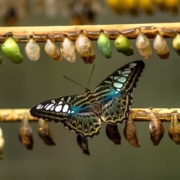
American culture in particular puts a premium on the emerging butterfly but often devalues the journey which is where the actual transformation happens! The journey to real change is messy, confusing, chaotic and uncertain. Those are qualities that tend to fall into the shadow side of life and are often dismissed as problems to be solved rather than a part of the process.

We could be like the caterpillar that yields to its unfoldment. We could have our faith restored in our resourcefulness. That is the gift of the inner journey. Such a gift renews our respect for the process of “the healing we took birth for.”

I’ll leave you with a poem that I hope you find restorative.

Chrysalis Diary / by Paul Fleischman

November 13

Cold told me to fasten my feet to this branch, to dangle upside down from my perch, to shed my skin, to cease being a caterpillar and I have obeyed.

December 6

Green—the color of leaves and life has vanished, the empire of leaves lies in ruins, lies in ruins! I study the brown new world around me. I fear the future. Have others of my kind survived this cataclysm? Swinging back and forth in the wind, I feel immeasurably alone.

January 4

I can make out snow falling for five days and nights it’s been drifting down.
I find I never tire of watching the flakes in their multitudes passing by my window. The world is now white. Astounding.

Astounding. I enter these wondrous events in my chronicle knowing no reader would ever believe me.

February 12

Unable to see out at all this morning, an ice storm last night. Yet I hear boughs cracking and branches falling. Hungry for sounds in this silent world I cherish these and ponder their import miser them away in my memory and wait for more.

March 28

I wonder whether I am the same being who started this diary—I’ve felt stormy like the weather without. My mouth is reshaping and my legs are dissolving—wings are growing, my body’s not mine, my body’s not mine.

This morning a breeze from the south strangely fragrant—a red-winged blackbird call in the distance—a faint glimpse of green in the branches—
and now I recall last night I dreamt of flying.

Cuppa Green Tea

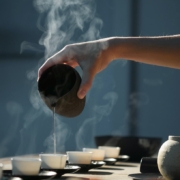
“Making a cup of green tea, I stopped the war.” ~ Paul Reps

I’ve loved this quote for decades and like all Zen koans, it ages well. How I’d say it now is: when I give full awareness to what is happening in this moment, I stop the war and my mind & body are nowhere else, there’s no conflict.

An American student of mine shared her dilemma: her partner is Chinese and he has a daughter. However, there’s great pressure for my student to bring her partner a son. She lives in China with him and is subject to the cultural norms.

Her partner and his mother are pushing her to go through repeated courses of In Vitro Fertilization. Her body is screaming to stop–her Chinese family pushes her to do more. She had the insight in our session to ask if this was normal? Of course it’s not normal, at least not by her own standards and her own standards matter; she’s slowly reclaiming that truth.

She admitted that for most of her life she has defined herself as the one who fills the void in other peoples’ lives so she can feel loved. However she navigates going forward, she now has the awareness of the unconscious beliefs causing her so much suffering. There’s a self violation that occurs in order to survive a complex situation. Most of us, if we’re honest have done this as well.

There’s no shame in our survival strategies. What’s important is that we learn how to come to the moment when we too could make a cup of green tea & stop the internal war.

Avoidance is Not Peace

I grew up in a household with plenty of conflict, most of which was never worked through. Each of us was wounded and exiled in our own way.

Some people are “conflict averse” and with good reason: people get hurt. What I’ve discovered is what can cause more harm is to avoid conflict. If the **only thing** I know how to do is avoid conflict, I am not creating peace I am perpetuating disconnection from my own vitality and from others.

Workability and Repair

“Workable” means that it’s not necessarily easy but there’s a willingness to stay with the process of repair. “Repair” invites us into the territory of forgiveness. I’m not convinced anymore that forgiveness is possible in every situation; ultimately yes but in the day to day, I am not so sure. Recognizing our limitations is an act of self respect and healing in itself. To remain open to the possibility of repair while not forcing it, can be enough.

I’d read a story of a holocaust survivor who admitted that she could never forgive her perpetrators but she knew she could teach her children and grandchildren about kindness. She knew her limits but those limitations did not prevent her from doing the good she could do.

The repair process can take moments, decades or even beyond this life. We have the choice of tilling the hard and soft places within our own hearts long after those who have harmed us or whom we have harmed, are no longer here. Our inner work never ends. That idea can be daunting if we believe that inner work is only important in a crisis. Consistent emotional hygiene is required to discover the courage needed for real peace: in ourselves and in our communities.

Inner work and outer work are inseparable. “Workability” and “Repair” offer alternatives to the ambivalence most of us carry about conflict.

We stay safe

Repair, workability and forgiveness are not code for putting ourselves in harm’s way based on fantasies of heroics. We must have the humility to tell ourselves and others the truth about our limits.

Self knowledge and self awareness are key to working with the truth of conflict. A safe holding space for the hard conversations is essential. Our safety is non negotiable. Our vitality ought not be negotiable either and it’s deadening when we allow our life force to be siphoned off by living a life of avoidance that we mistake for “peace”.

Wabi Sabi Perfection in the Imperfection

Often when we are called to do our inner work, there’s a subtle but stubborn belief that we are “improving ourselves”: that we’re going to get rid of that old, tired, dingy self and come out with a brand new version. In fact a popular phrase is: “becoming the best version of oneself.” Honestly? I have no idea what that phrase actually means but it evokes exhaustion in me whenever I hear it.

Many of us have tried various self improvement techniques and continue to suffer because the starting assumption is not correct: if I’m unhappy, uncomfortable, dismayed, freaked out or despairing, there must be something wrong with me! The definition of a “normal” life is so narrow that anything on either side of that tightrope is terrifying. We’ve somehow gotten far away from accepting that these various states are part of being human.

To open toward our humanity rather than push away what we think are flaws, is gently learning to embrace what ails us and to discover that what ails us is the gateway to restoring our sanity. This is the practice of wabi sabi–seeing the perfection in the imperfection. We’re not seeking the “best version of ourselves”–we are opening to the possibility that the best version of ourselves is already here.

Faith & Disorientation

“Faith is a small movement, slow but steady & sure, holding all our experience in a clear circle of compassionate light.” ~K. Patel

It’s fair to say that most of our lives have been upended by the past 2 years of living with a pandemic. And that’s only what’s gone on collectively. There’s the personal challenges that have happened for each of us as well.

We’ve all been impacted and yet we don’t all have a context. What we are going through is known in the transitions process as “Disorientation”. Here’s what William Bridges, author of the book “Transitions” has to say about disorientation:

“Traditional people in passage did not enjoy or embrace the experience of disorientation. They suffered through it because that was the way, which is to say they had faith in the death and rebirth process. Having that faith they did not need to try to make distress comfortable. However, many modern people lacking that faith are caught between positive thinking and despair, keeping themselves going by lighting matches and whistling in the dark.”

Disorientation is only one part of a transition process. What’s essential to know is that life moves in a circle, not a straight line. In our embrace of linear thinking exclusively, we lose track of the life/death/rebirth reality of life. Under conditions like the relentlessness of these times, linear thinking is a quick path to despair as we toggle between hope and fear.

Everything in this life has a beginning and an end and every ending offers the promise of a new beginning: in between those two places is disorientation.

Accepting that all things come to an end requires faith in the circular nature of life and in our capacity to familiarize ourselves and trust in the natural phases of all change.

(“Transitions:Making Sense of Life’s Changes” William Bridges, PhD/Addison-Weslely Publishing, 1980)