
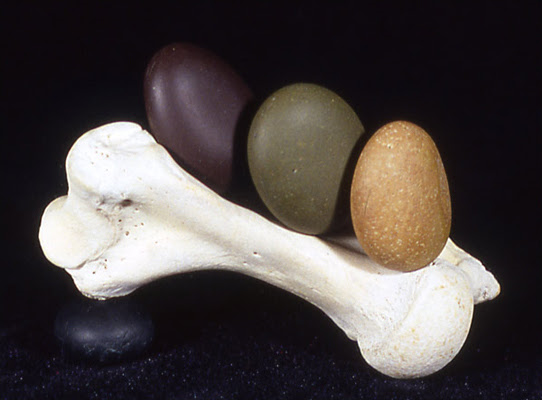
Bone Deep
Not too long ago I received a call that a friend’s spine was collapsing from advanced osteoporosis.
I arrived at the hospital the next day, when she and her doctor were consulting on a procedure that injects cement into the vertebrae, to rebuild the structure. Her blue eyes loomed large in the bed when she asked me what she should do: I asked her to consider what other choices she might have? She was fortunate in that the procedure offered her new found structure after years of spontaneous fractures. Her recovery has been complicated by chaos in her personal life and chaos in a failing medical system. Though they poked, prodded and tested her to prescribe the proper medications, nothing was done about helping her walk again or reclaiming confidence in her ability to move.
After the spine began healing and life had some semblance of order, we began our work together: Exploring the invisible weave of biomechanics, mind and heart.
”We begin as a bundle of bones lost somewhere in a desert, a dismantled skeleton that lies under the sand. It is our work to recover the parts.” ~CP Estes
One moment she’d be enthralled with feeling her body move in ways she’d forgotten. Then she’d share with me the terror of falling, of fracturing, of spending her days in a body that could shatter like a bone china cup. And then return to the moment with a “Thank you for listening to my anxieties…”
And who would not be anxious? Our fear of falling is woven tightly into the fabric of our being. Yet, fall we will. It’s making friends with gravity and ourselves, that’s key.
As we worked together she bravely went to the ground with the help of a chair, a slow descent to a padded floor. She was terrified and confused. She wanted to do it “right”. But there is no right way to move: there’s the strategies we have in the moment. And strategies serve or we’d never develop them. It’s too much of a high wire act to ask someone in recovery to move “perfectly”. And what does “perfectly” mean? Who decides? I encouraged her to check in with her own sensation, her own inner experience. Women are particularly vulnerable to other peoples’ opinions about their body and experience. Our subjective experience has value. Equal value to any other input.We explored slowly. Some peoples’ pride is offended by the sometimes slow pace of this work: “I’m tough, I can do more!” They do know how to be tough, but they don’t know how to get from A—->B.
Healthy vulnerability is necessary for recovery. A wise mentor once said we move through life from dependence as young children, to independence as teenagers and then interdependence as emotionally mature adults.
When engaged in months or years of recovery, the willingness to receive support, accept our limits, and be vulnerable, keeps our humanity intact, our tasks do-able, and our spirits resilient. My friend and I continue our journey together: It offers her wholeness, not adaptive strategies. She’s driving, walking with hiking poles, tending her inner life, and also has her darker moments too. And she continues to be diligent with our work together. I see the day when she’ll walk round the lake near her home. Or come by for breakfast. Her life is forever altered. Her experience is a reminder that our body mediates our relationship with the world.
We need support for our confidence to grow “bone deep”.


Leave a Reply
Want to join the discussion?Feel free to contribute!